Centralization of Local Philanthropy: A Social Network Analysis of Donor–Beneficiary Ties in Serbia and Bosnia and Herzegovina
Abstract
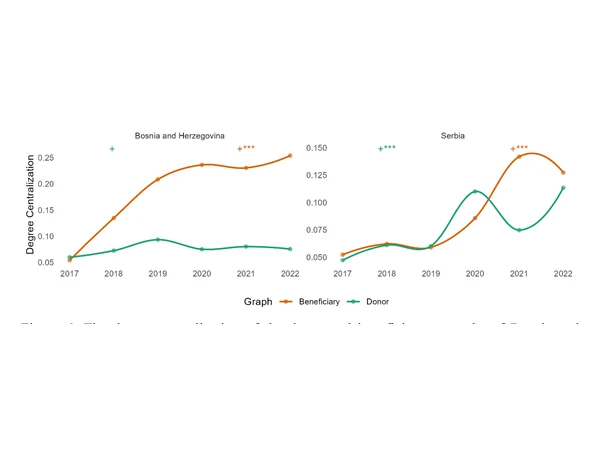
In Serbia and Bosnia and Herzegovina, post-socialist countries local philanthropy is gaining importance as external aid diminishes. This paper examines the changing structure of these local giving ecosystems between 2015 and 2022. Social network analysis is used to map the relationships between donors and beneficiaries, treating each donation as a relational tie rather than as a financial flow, and examining the structure of giving rather than its volume. Key metrics tracking network centralization, but also density and cliquishness, showed changes over the years. There is a significant trend towards network centralization in both countries: philanthropic activity is increasingly concentrated around fewer central entities, potentially marginalizing smaller groups. While number of connections generally increased, dense collaborative clusters did not strengthen uniformly. Consolidation presents potential efficiencies alongside risks for the sector’s diversity and inclusivity. This paper provides an empirical basis for designing strategies that counteract centralization and support a more distributed local giving ecosystem.


BibTeX
@article{galjak_centralization_2026,
  title = {Centralization of {Local} {Philanthropy}: {A} {Social} {Network} {Analysis} of {Donor}–{Beneficiary} {Ties} in {Serbia} and {Bosnia} and {Herzegovina}},
  issn = {1468-3857, 1743-9639},
  shorttitle = {Centralization of local philanthropy},
  url = {https://www.tandfonline.com/doi/full/10.1080/14683857.2026.2716929},
  doi = {10.1080/14683857.2026.2716929},
  language = {en},
  urldate = {2026-08-12},
  journal = {Southeast European and Black Sea Studies},
  author = {Galjak, Marko and Budić, Marina},
  month = aug,
  year = {2026},
  pages = {1--23},
  keywords = {Philanthropy networks, social capital, Western Balkans, social network analysis},
}