Trust Over Creepiness: AI Chatbot Perceptions in Balkan Countries
Abstract
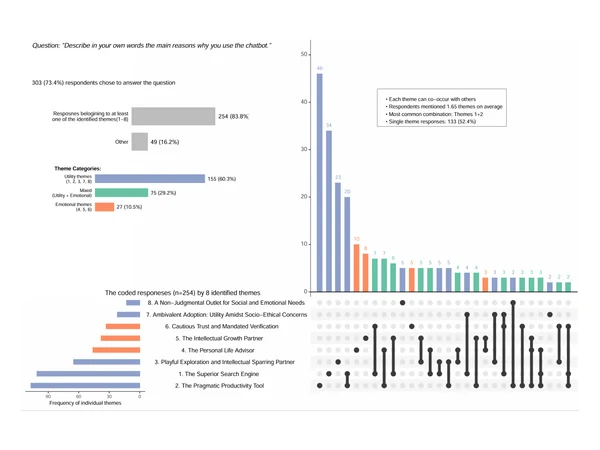
Generative AI research remains predominantly Western-centric. This mixed-methods study replicates Baek and Kim’s (2023) chatbot acceptance model in the Balkan region (Bosnia and Herzegovina, Croatia, Montenegro, and Serbia). Surveying users (N=413), we validated the psychometric scales but found significant structural differences compared to the original US data. Specifically, task efficiency did not influence trust or creepiness. Conversely, playfulness emerged as a key predictor, reducing creepiness and building trust. While the US study found creepiness strongly deterred use, our sample showed trust was the dominant driver of continuance intention. Thematic analysis of open-ended responses identifies an "instrumentalist mindset", users perceive AI as a pragmatic tool rather than a social agent, explaining the emotional decoupling of efficiency from creepiness. The results demonstrate that Western-validated HCI models require cultural adaptation. We recommend that designers targeting similar contexts prioritize utility and transparency over anthropomorphic features.


BibTeX
@article{galjak_trust_2026,
  title = {Trust {Over} {Creepiness}: {AI} {Chatbot} {Perceptions} in {Balkan} {Countries}},
  volume = {0},
  url = {https://doi.org/10.1080/10447318.2026.2638548},
  doi = {10.1080/10447318.2026.2638548},
  number = {0},
  journal = {International Journal of Human–Computer Interaction},
  publisher = {Taylor \& Francis},
  author = {Galjak, Marko and Budić, Marina},
  month = mar,
  year = {2026},
  note = {\_eprint: https://doi.org/10.1080/10447318.2026.2638548},
  pages = {1--25},
  keywords = {Uses and Gratifications Theory, ChatGPT, Large Language Models, Structural Equation Modeling, Uncanny Valley, Post-socialist context, User Motivation},
  project = {BCMSAI}
}